
Carbide Inserts, Reamers, Taps, and Boring Bars: High-Performance CNC Tooling from MTM Tooling, Indore
Explore CCMT and APKT carbide inserts, carbide reamers, long-life taps, and damped boring bars for...
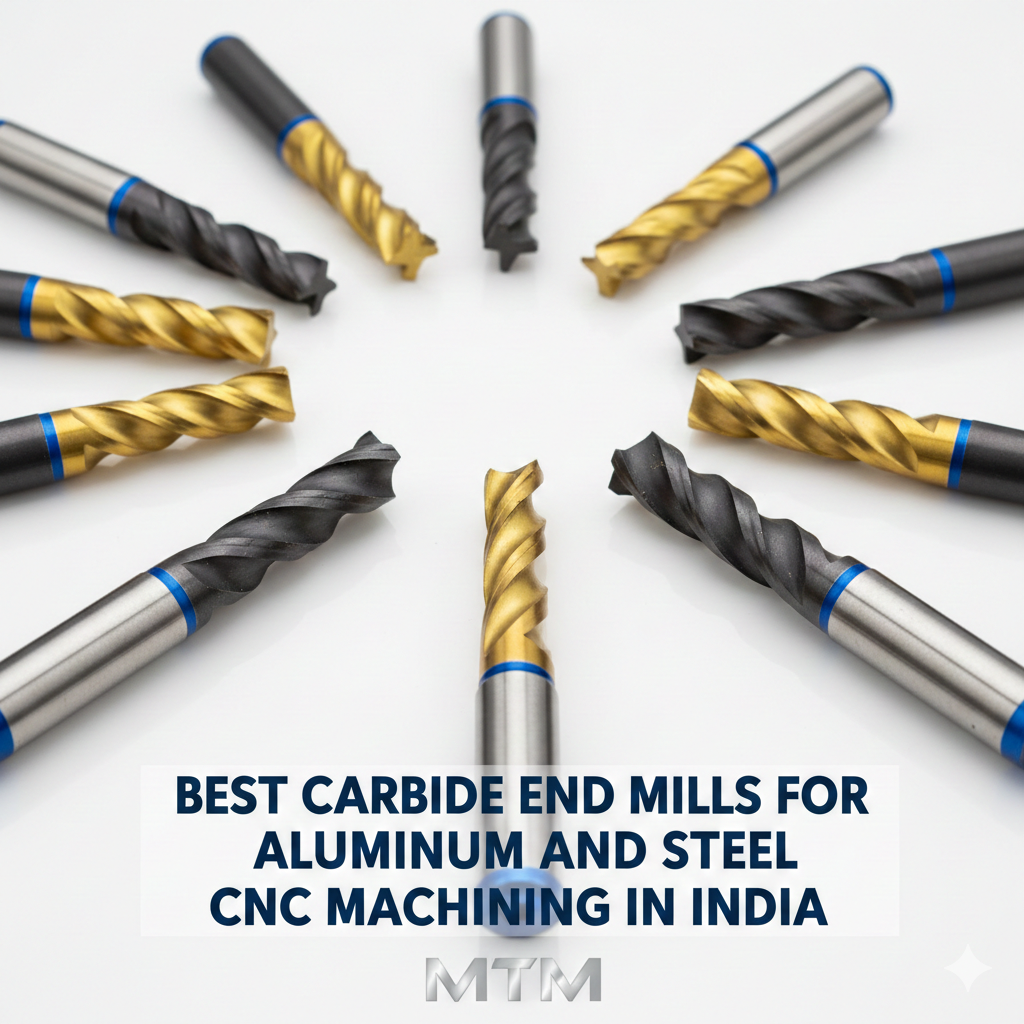
The difference between a mediocre finish and a precision part often comes down to one decision: choosing the right carbide end mill. For CNC machine operators and procurement teams in India, this choice directly impacts tool life, production speed, and part quality.
End mills are the workhorse of CNC milling operations, yet many shops treat them as interchangeable commodities. They're not. A carbide end mill optimized for aluminum cutting will fail prematurely when used on stainless steel. A high-helix design that excels in soft materials may generate heat and chatter on hardened steel. The cost? Broken tools, wasted material, missed deadlines, and frustrated teams.
This guide cuts through the confusion. We've documented the specifications, applications, and performance characteristics of the carbide end mills that professional CNC operators in India rely on—whether they're running small desktop mills or high-speed VMCs (Vertical Machining Centers).
Before diving into specific products, understand the fundamental choice: Carbide or High-Speed Steel (HSS)?
Carbide End Mills are manufactured from tungsten carbide, a composite material that's significantly harder than HSS. They offer:
When to choose carbide: High-volume production, hard materials (stainless steel, cast iron), precision work, aluminum machining at spindle speeds above 5,000 RPM.
HSS End Mills remain relevant for:
MTM Tooling Recommendation: For production work and consistent quality, carbide is the economical choice despite higher per-unit cost. Tool life extension and increased throughput justify the investment.
The number of flutes (cutting edges) fundamentally changes how an end mill behaves:
| Flute Count | Best For | Chip Clearance | Feed Rate | Surface Finish |
|---|---|---|---|---|
| 2 Flute | Aluminum, soft materials | Excellent | Moderate | Good |
| 3 Flute | Aluminum, compromise geometry | Very Good | Good | Very Good |
| 4 Flute | Steel, cast iron, hardened materials | Adequate | Excellent | Excellent |
| High Flute (5+) | Titanium, extreme hardness | Limited | Slow | Excellent for finishing |
Critical Rule for Aluminum: Never exceed 3 flutes unless you want broken tools. Aluminum produces large chips that require space to evacuate from the cutting zone. Four flutes in aluminum confined cuts = tool breakage.
For Steel and Stainless: 4 flute is optimal. The additional flutes act as a "spindle multiplier"—at the same RPM, you can feed 2x faster than a 2-flute, significantly boosting productivity.
Carbide end mill coatings are thin layers (2-4 microns) that dramatically extend tool life and speed capability:
| Coating | Application | Temperature Resistance | Cost | Best For |
|---|---|---|---|---|
| TiAlN (Titanium Aluminum Nitride) | Steel, stainless, cast iron | 900°C | Medium | Toughness + speed balance |
| TiCN (Titanium Carbonitride) | General purpose, softer materials | 800°C | Budget-friendly | Volume work, aluminum |
| CrN (Chromium Nitride) | Aluminum, non-ferrous | 600°C | Low-cost | High-speed aluminum work |
| Multi-layer (TiAlN + CrN) | Mixed material batches | 1000°C+ | Premium | Extreme durability |
| Uncoated | Aluminum production | N/A | Lowest cost | High-volume soft material shops |
MTM Tooling Analysis: TiAlN-coated carbide end mills represent the best value for Indian CNC shops. They handle aluminum, steel, and stainless steel with minimal tool changes and extend tool life 3-5x versus uncoated.
Application: Automotive components, electrical enclosures, heat sinks, aerospace brackets
Specifications:
MTM Tooling 3-Flute Aluminum Series:
Why 3-Flute for Aluminum? The geometry provides superior chip evacuation for large aluminum chips while maintaining feeding speed. The 60° helix angle pulls chips upward efficiently, preventing jamming and tool breakage.
Performance Data:
Real-World Example: A Delhi-based automotive supplier machining aluminum transmission housings achieved 40% higher daily output by switching from 2-flute uncoated to 3-flute TiCN-coated end mills, despite a 3x higher per-tool cost.
Application: Steel components, mold manufacturing, precision fixtures, hardened steel up to 65 HRC
MTM Tooling 4-Flute Steel Series - 10mm Diameter:
| Coating | Uncoated | TiCN | TiAlN | Multi-coat |
|---|---|---|---|---|
| Price | ₹850 | ₹1,200 | ₹1,500 | ₹2,200 |
| Tool Life (m) | 800 | 2,400 | 3,500 | 5,000+ |
| Max Speed (m/min) | 150 | 250 | 350 | 400+ |
| Recommended Material | Mild steel | General steel | Stainless, hardened | Titanium, exotic alloys |
Complete Specifications:
Optimal Parameters for Steel (10mm 4-flute TiAlN):
Why 4-Flute Matters: At identical RPM, a 4-flute end mill cuts 2x faster than 2-flute. For shops running 20+ parts daily, this doubles productivity without spindle upgrades.
Application: 3D mold surfaces, sculptured aerospace parts, cavity finishing, radius features
Key Advantages of TiAlN Coating on Ball Nose:
MTM Tooling TiAlN Ball Nose Series:
| Diameter | Standard Price | Bulk Price (10+) | Tool Life (std steel) | Best For |
|---|---|---|---|---|
| 3mm | ₹1,100 | ₹850 | 1,200m | Fine details, small cavities |
| 4mm | ₹1,300 | ₹1,000 | 1,500m | General cavities |
| 6mm | ₹1,600 | ₹1,250 | 2,000m | Medium molds |
| 8mm | ₹1,900 | ₹1,500 | 2,500m | Large surfaces |
Technical Specifications:
Performance Parameters for Steel:
Ordering Tip: Purchase in sets of 5-10 if running multiple mold cavities. Bulk pricing saves ₹250-400 per tool.
Application: Stainless steel 304/316 components, surgical instruments, pump bodies, valves, threaded holes
Why Variable Helix for Stainless Steel?
Stainless steel produces long, stringy chips and generates significant heat during cutting. Variable helix end mills solve both problems:
MTM Tooling Variable Helix Stainless Series:
| Size | 4mm | 6mm | 8mm | 10mm |
|---|---|---|---|---|
| Type | 4-flute VH | 4-flute VH | 4-flute VH | 4-flute VH |
| Coating | TiAlN | TiAlN | TiAlN | TiAlN |
| Price (Single) | ₹1,800 | ₹2,100 | ₹2,400 | ₹2,800 |
| Price (5-pack) | ₹8,500 | ₹9,800 | ₹11,000 | ₹13,000 |
| Tool Life (m) | 1,800 | 2,400 | 3,200 | 4,000+ |
Specifications:
Recommended Parameters (Stainless 304):
Real-World Case: A Pune medical device manufacturer reduced tool breakage in stainless by 65% and tool cost per part by 40% by switching to variable helix from standard geometry—despite 2x higher tool cost.
Application: Cavity roughing, pocket hogging, aluminum aerospace brackets, high-volume small-part production
What Makes Roughing End Mills Different?
Roughing end mills feature serrated teeth (tiny saw-like edges) that:
MTM Tooling Roughing Series Specifications:
| Diameter | Material | Coating | Price | Tool Life | Best For |
|---|---|---|---|---|---|
| 8mm | Carbide | TiAlN | ₹950 | 1,200m | Aluminum cavities |
| 10mm | Carbide | TiAlN | ₹1,100 | 1,600m | Steel roughing |
| 12mm | Carbide | TiAlN | ₹1,400 | 2,000m | Large pockets |
| 16mm | Carbide | TiAlN | ₹1,800 | 2,500m | Heavy roughing |
Cutting Parameters:
Why Use Them: A 12mm roughing end mill at aggressive feeds removes material faster than finishing passes with smaller tools, dramatically reducing total cycle time.
| Material | Best End Mill Type | Flute Count | Coating | Speed Range | Feed Strategy |
|---|---|---|---|---|---|
| Aluminum 6061 | 3-flute square, high helix | 3 | TiCN/Uncoated | 3,000-8,000 RPM | Aggressive feeds 0.1-0.2 mm/tooth |
| Stainless 304 | 4-flute variable helix | 4 | TiAlN | 1,500-2,500 RPM | Moderate, 0.05-0.1 mm/tooth |
| Mild Steel | 4-flute standard | 4 | TiAlN | 2,500-4,500 RPM | Standard 0.08-0.15 mm/tooth |
| Cast Iron | 4-flute edge broken | 4 | TiAlN | 1,500-3,000 RPM | Conservative 0.05-0.1 mm/tooth |
| Titanium | High-flute (5+) | 5-6 | TiAlN/Multi | 800-1,500 RPM | Very light 0.03-0.08 mm/tooth |
Aluminum Series (3-Flute TiCN):
Steel Series (4-Flute TiAlN):
Custom Specifications:
| Order Volume | Discount | Minimum Order |
|---|---|---|
| 5-9 tools | 8-12% | Single SKU |
| 10-24 tools | 15-20% | Single SKU |
| 25+ tools | 22-30% | Single or mixed |
| Monthly contract (50+) | 25-35% + free delivery | Mixed SKUs |
Step 1: Identify Material Being Cut
Step 2: Determine Available Spindle Speed
Step 3: Calculate Tool Life ROI
Step 4: Verify Stickout and Rigidity
MTM Tooling offers:
The transition from HSS or budget carbide to precision-engineered end mills from MTM Tooling isn't an expense—it's an investment in:
For CNC shops across Maharashtra, India, and beyond, carbide end mills optimized for your specific material and application are non-negotiable for competitive manufacturing.
Explore CCMT and APKT carbide inserts, carbide reamers, long-life taps, and damped boring bars for...
Most CNC shops spend their upgrade budget on spindle power, controller brands, or premium tool...